Amazon and Shopify Are Now Half of U.S. E-Commerce
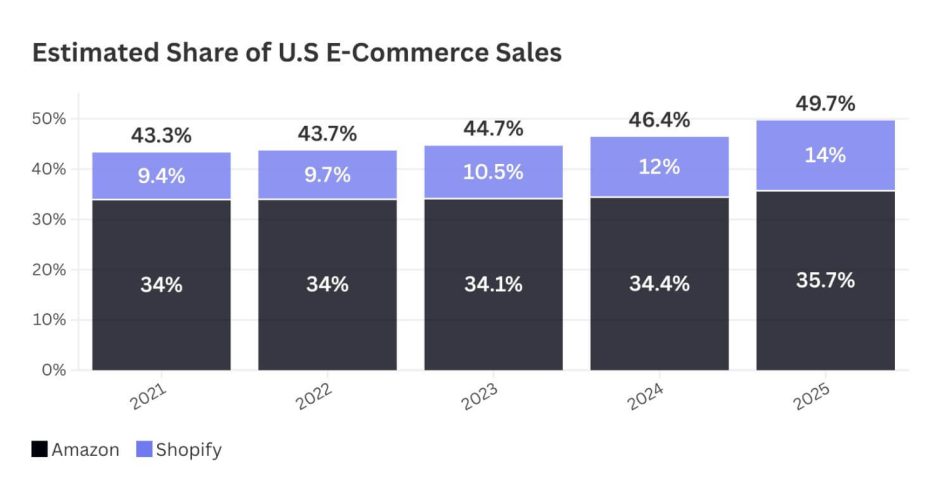
As of February 2026, Amazon and Shopify together account for approximately 50% of the U.S. e-commerce market. This significant milestone highlights the growing dominance of these two platforms in the online retail space. According to estimates from Marketplace Pulse, Amazon generated roughly $440 billion in U.S. sales in 2025, capturing a 35.7% share of the overall $1.2 trillion U.S. e-commerce market.
Amazon’s Market Share
Amazon’s impressive market share is attributed to its extensive retail and marketplace operations. The platform has become a go-to destination for consumers looking to shop online, making it a formidable player in the e-commerce landscape. In 2025, Amazon’s sales represented a significant portion of the total e-commerce revenue, underscoring its influence and reach.
Shopify’s Growing Presence
Shopify, on the other hand, reported a U.S. market share of 14% in its Q4 2025 earnings call, up from 12% the previous year. This marks only the second time Shopify has provided a market share figure, indicating the company’s growing confidence in its position within the e-commerce ecosystem. Shopify’s model differs from Amazon’s, as it aggregates sales from millions of independent merchant storefronts, each with its own unique brand identity.
Combined Market Share
The combined market share of Amazon and Shopify stands at 49.7%. This figure reflects the substantial growth both companies have experienced over the past few years. As recently as 2021, Amazon and Shopify together held an estimated 43% of the U.S. e-commerce market. The gap between them has closed gradually through 2022 and 2023, accelerating in the last two years as both companies have continued to expand in a maturing market.
Shopify’s Unique Position
Shopify’s public acknowledgment of its market share is particularly noteworthy. Traditionally, retail market share is a metric for destinations where consumers shop, such as Amazon and Walmart. However, Shopify’s model, which aggregates the gross merchandise volume (GMV) from numerous independent storefronts, positions it more like a payment network than a traditional retailer. This shift in perspective reflects the industry’s growing acceptance of Shopify’s scale as a valid measure of its market presence.
Comparative Growth
Shopify’s global GMV reached $378 billion, which is now 66% as large as Amazon’s third-party marketplace GMV of $575 billion. This is a significant increase from 40% in 2020 and 25% in 2018, showcasing Shopify’s rapid growth and the increasing importance of its platform in the e-commerce landscape.
Divergent Models of E-Commerce
The two companies represent different approaches to organizing online commerce. Amazon operates as a centralized marketplace where sellers can list their products, but consumers primarily interact with Amazon itself. In contrast, Shopify allows merchants to maintain ownership of their storefronts, customer relationships, and brand identities, enabling them to sell directly to consumers who visit their individual sites.
Other Players in E-Commerce
While Amazon and Shopify dominate the e-commerce landscape, the remaining half of the market is increasingly competitive. Walmart remains a significant player, with its marketplace estimated at roughly $10 billion in GMV, which is still a fraction of Amazon’s volume. eBay reported $39.1 billion in U.S. GMV in 2025, focusing on enthusiasts and collectors rather than competing with Amazon for new-in-season goods.
Emerging Competitors
Other platforms are also making their mark in the e-commerce space. TikTok Shop reached an estimated $15.1 billion in U.S. GMV in 2025, marking a substantial achievement for a platform in its second full year of operation. However, this figure still pales in comparison to the two leaders. Additionally, platforms like Temu and Shein cater to the ultra-low-price segment, though their advantages are diminishing.
Market Dynamics
As the e-commerce landscape evolves, the distinction between centralized marketplaces like Amazon and decentralized infrastructures like Shopify remains intact, despite some overlap. Both models have reached maturity around the same time, leading to a more organized U.S. e-commerce environment. The competition among other players is intensifying as they seek to carve out their niches in this dynamic market.
Conclusion
The rise of Amazon and Shopify as dominant forces in U.S. e-commerce illustrates the changing dynamics of online retail. Their combined market share of nearly 50% signals a shift in how consumers shop and how businesses operate in the digital marketplace. As these two platforms continue to grow, the rest of the e-commerce landscape must adapt to remain competitive.
Frequently Asked Questions
Amazon and Shopify together account for approximately 50% of U.S. e-commerce as of 2026.
Amazon generated roughly $440 billion in U.S. sales in 2025.
Shopify reported a U.S. market share of 14% in its Q4 2025 earnings call.
Note: The figures and statistics mentioned in this article are based on estimates and reports available as of February 2026.