
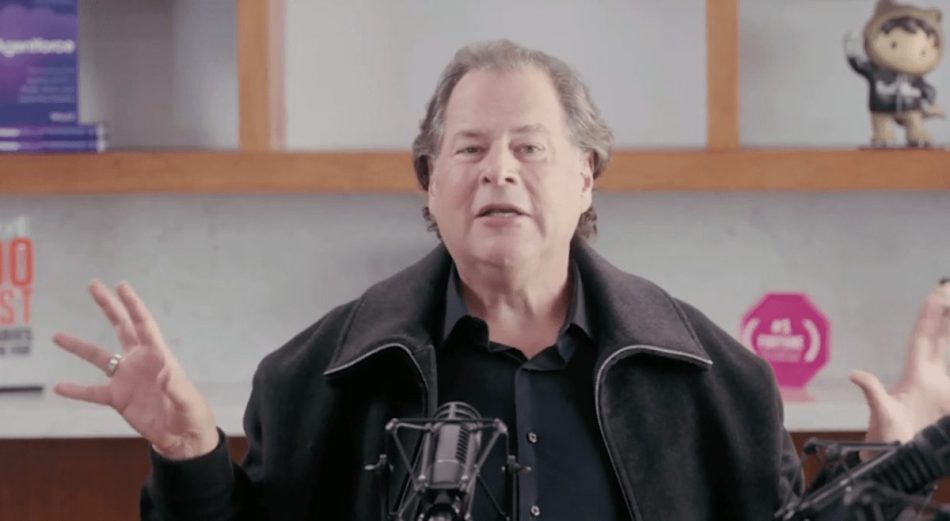
Salesforce CEO Marc Benioff: This isn't our first SaaSpocalypse
In a recent earnings call, Salesforce CEO Marc Benioff addressed the concerns surrounding the rise of artificial intelligence (AI) and its potential impact on the software-as-a-service (SaaS) industry. With the company reporting impressive financial results, Benioff aimed to reassure investors that Salesforce would not succumb to the so-called “SaaSpocalypse.”
Salesforce’s Financial Performance
Salesforce announced a fourth-quarter revenue of $10.7 billion, marking a 13% increase year-over-year. For the entire fiscal year, the company reported $41.5 billion in revenue, up 10% from the previous year. A significant factor contributing to this growth was Salesforce’s $8 billion acquisition of data management company Informatica in May 2025.
Net income for the quarter reached $7.46 billion, and the company provided optimistic guidance for the upcoming year, projecting revenue between $45.8 billion and $46.2 billion, which represents a 10% to 11% increase. Salesforce’s remaining performance obligation (RPO), a metric indicating revenue under contract that has not yet been recognized, stands at over $72 billion.
The SaaSpocalypse Concern
Despite these strong financial results, the SaaS sector, with Salesforce at the forefront, has faced significant challenges. Investors have expressed concerns that the emergence of AI agents could disrupt traditional SaaS business models, leading to a decline in demand for per-employee-seat software solutions. This phenomenon has been dubbed the “SaaSpocalypse.”
During the earnings call, Benioff emphasized the term “SaaSpocalypse,” using it multiple times to highlight the ongoing challenges faced by the industry. He stated, “You’ve heard about the SaaSpocalypse? And it isn’t our first. We’ve had a few of them.” He further added, “If there is a SaaSpocalypse, it may be eaten by the Sasquatch because there are a lot of companies using a lot of SaaS because it just got better with agents.”
Salesforce’s Strategic Moves
In a bid to reassure investors and demonstrate its resilience, Salesforce implemented several strategic initiatives. The company increased its dividend by nearly 6% to $0.44 per share and announced a new $50 billion share buyback program. Share buybacks are often viewed favorably by shareholders as they can help boost stock prices by reducing the number of shares in circulation.
Additionally, Salesforce revamped its earnings call format. The presentation was part podcast, part infomercial, and included interviews with three Salesforce customers who praised the company’s new AI agent products. Notable participants included the CEOs of SharkNinja, Wyndham Hotels and Resorts, and SaaStr, a prominent software industry conference and media company.
Introducing Agentic Work Units
Salesforce also introduced a new metric called “agentic work units” (AWU) during the earnings call. This metric aims to measure the effectiveness of AI agents in completing tasks rather than simply counting the volume of AI processing. Salesforce president and CMO Patrick Stokes explained that AWU focuses on verifiable actions taken by the AI, such as writing to a record, rather than less meaningful tasks.
In the previous quarter, Salesforce logged 19 trillion tokens, a standard unit of AI processing volume. However, Stokes emphasized that the true value lies in the ability of AI agents to perform specific tasks that enhance productivity in enterprise settings.
Salesforce’s Vision for the Future
Salesforce presented its architectural vision for the future of SaaS and AI during the earnings call. The company envisions a landscape where SaaS providers like itself dominate the tech stack, while AI model makers serve as foundational, interchangeable engines. This vision directly counters concerns raised by the recent release of OpenAI’s enterprise agent, Frontier, which positions OpenAI at the top of the stack.
Benioff’s presentation style was also noteworthy; he donned a black leather jacket reminiscent of Nvidia CEO Jensen Huang, who is recognized for his success in the AI sector. This choice of attire was likely intended to convey confidence and assertiveness in Salesforce’s position within the evolving tech landscape.
Conclusion
As Salesforce navigates the challenges posed by the rise of AI, the company remains committed to its growth and innovation. With strong financial results, strategic initiatives, and a clear vision for the future, Salesforce aims to reassure investors that it can thrive in an era characterized by rapid technological change.
Frequently Asked Questions
The SaaSpocalypse refers to the concerns that the rise of AI agents could disrupt traditional software-as-a-service business models, potentially leading to a decline in demand for these services.
Salesforce reported fourth-quarter revenue of $10.7 billion, a 13% increase year-over-year, and a net income of $7.46 billion.
Agentic work units (AWU) are a new metric introduced by Salesforce to measure the effectiveness of AI agents in completing specific tasks, rather than merely counting processing volume.
Note: This article is based on information available as of February 2026 and may be subject to change as new developments occur.