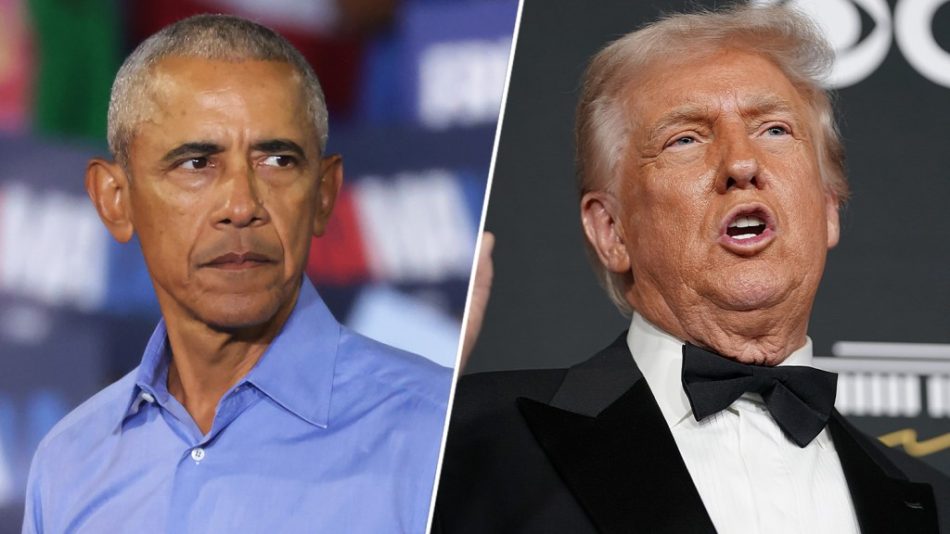
Barack Obama Breaks Silence On “Deeply Troubling” Trump-Posted AI Video Depicting Him As Ape
In a recent interview, former President Barack Obama addressed a controversial AI-generated video that was posted on Donald Trump’s Truth Social account, which depicted him and former First Lady Michelle Obama as apes. This incident has sparked significant public outrage and discussions about the implications of artificial intelligence in political discourse.
Obama’s Response
Obama described the video as “deeply troubling,” emphasizing that the majority of Americans find such behavior unacceptable. He expressed concern over the current state of social media, referring to it as a “clown show” that lacks decorum and respect for the office of the presidency. In his interview with Brian Tyler Cohen, Obama stated:
“First of all, I think it’s important to recognize that a majority of the American people find this behavior deeply troubling. It is true that it gets attention. It’s true that it’s a distraction. But as I’m traveling around the country, as you’re traveling around the country, you meet people, they still believe in decency, courtesy, kindness.”
The Context of the Video
The video in question was posted by Trump, who later attempted to distance himself from the content by blaming a staffer for the post. Trump claimed that the staff member had not been fired and defended the video as part of a larger commentary on voter fraud, suggesting it was a parody related to “The Lion King.”
Public Reaction
Reactions to the video have been mixed. Some, like Karoline Leavitt, defended the video as a form of parody, dismissing the public outrage as “fake outrage.” However, the video was removed shortly after its posting, indicating that even within Trump’s camp, there was recognition of its inappropriateness.
Social Media’s Role in Political Discourse
Obama’s comments highlight a growing concern about the role of social media in shaping political narratives and public perceptions. He lamented the loss of a sense of propriety and respect for political institutions, suggesting that the current climate allows for behavior that would have previously been considered unacceptable. He stated:
“There doesn’t seem to be any shame about this among people who used to feel like you had to have some sort of decorum and a sense of propriety and respect for the office. So, that’s been lost.”
The Broader Implications
The incident raises important questions about the use of AI in media and its potential to perpetuate harmful stereotypes and misinformation. With the rise of deepfake technology and AI-generated content, the boundaries of acceptable political commentary are increasingly blurred. Experts warn that such developments could lead to greater polarization and division among the electorate.
Concerns Over AI and Misinformation
The use of AI to create misleading or offensive content poses significant challenges for society. As technology advances, the ability to manipulate images and videos becomes easier, making it difficult for the public to discern fact from fiction. This situation calls for a more robust discussion about ethical standards in media and the responsibilities of those who create and share content.
Conclusion
Barack Obama’s response to the AI-generated video reflects a broader concern about the state of political discourse in the age of social media. As public figures navigate this complex landscape, it is crucial to prioritize decency, respect, and truthfulness in communication. The incident serves as a reminder of the power of media—both traditional and digital—and the responsibility that comes with it.
Note: The content discussed in this article is based on recent events and public statements made by Barack Obama and Donald Trump. The implications of AI in media and politics continue to evolve, prompting ongoing discussions about ethics and accountability.