
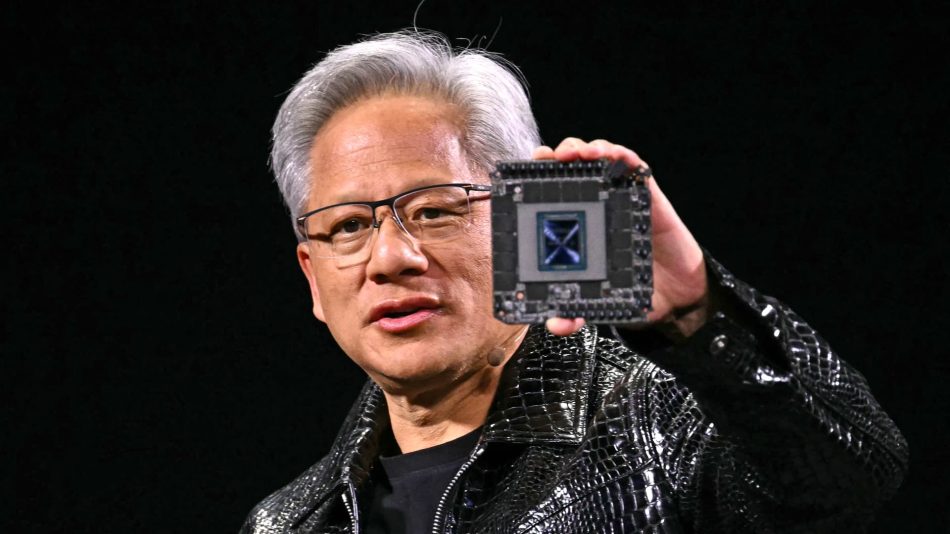
Nvidia’s Jensen Huang says markets ‘got it wrong’ on AI threat to software companies
In a recent statement, Nvidia CEO Jensen Huang expressed his belief that the markets have misjudged the potential impact of artificial intelligence (AI) on the software industry. During an interview with CNBC, Huang pushed back against the prevailing fears that AI agents would cannibalize the enterprise software sector. Instead, he argued that AI will enhance the use of existing software tools, ultimately boosting productivity.
Market Miscalculations
Huang’s comments come in the wake of Nvidia’s impressive earnings report, which revealed a 73% increase in revenue for the fiscal fourth quarter, amounting to $68.13 billion. This figure surpassed analysts’ expectations, which had forecasted revenue of $66.21 billion. Furthermore, Nvidia provided an optimistic guidance for the upcoming fiscal first quarter, projecting revenues of $78 billion, plus or minus 2%, well above the anticipated $72.6 billion.
AI as a Tool User
Huang articulated that AI agents should be viewed as tool users rather than replacements for existing software. He emphasized that these intelligent systems will leverage software tools to enhance their capabilities and improve efficiency. “That’s the reason why we also say agents are tool users,” Huang stated. He cited examples such as web browsers and Microsoft Excel, indicating that AI agents will utilize these tools to perform tasks more effectively.
Software Tools Remain Essential
According to Huang, the software tools currently in use, such as Cadence, Synopsys, ServiceNow, and SAP, exist for valid reasons. He believes that agentic AI will serve as intelligent software that utilizes these tools on behalf of users, ultimately helping them to be more productive. “Nobody’s going to service better than ServiceNow, and they’re going to come up with agents that are really fine-tuned and optimized for the work that uses the tools that they have,” he added.
Investor Sentiment and Software Stocks
Despite Huang’s optimistic outlook, investor sentiment remains cautious. The rapid increase in spending on AI hardware has led to concerns about sustainability, prompting fears of a potential bubble in the sector. In recent months, shares of software service providers have experienced significant declines. Analysts have raised alarms about the long-term risks posed by AI, suggesting that it could “eat” software companies.
Mixed Reactions in After-Hours Trading
Following Huang’s remarks, software stocks exhibited mixed performance in after-hours trading. For instance, Synopsys saw a decline of 3.6%, while Cadence dipped by 0.9%. Conversely, ServiceNow remained relatively unchanged, and SAP experienced a slight increase of 0.3%. This mixed reaction reflects the ongoing uncertainty surrounding the software industry in the context of AI advancements.
Long-Term Outlook
Dan Niles, founder and portfolio manager of Niles Investment Management, shared his perspective on the evolving landscape. He warned that while some companies may thrive, others could face significant challenges as AI automates workflows and lowers barriers for new competitors. “There are some real companies that are going to go to zero in the software space,” Niles stated, adding that the most resilient players will likely emerge from the database and cybersecurity sectors.
Reassessing the Software Industry
Despite the challenges, CNBC’s Jim Cramer expressed a more optimistic view, suggesting that fears of an AI-driven existential threat to software companies may be exaggerated. “The software companies are survivors. They can merge. They can adapt. They can do whatever is really necessary to get it so they stay in business,” Cramer remarked. He acknowledged that while software companies are currently priced for perfection, they possess the resilience to navigate the evolving market landscape.
Conclusion
As the conversation around AI and its implications for the software industry continues, Jensen Huang’s insights offer a counter-narrative to the prevailing fears. By highlighting the role of AI as a tool user rather than a replacement, he encourages a more nuanced understanding of how these technologies can coexist with existing software solutions. The future of the software industry may depend on its ability to adapt and integrate AI effectively, ensuring that both can thrive in an increasingly digital world.
Frequently Asked Questions
Jensen Huang stated that the markets have miscalculated the threat of AI to software companies, arguing that AI will enhance the use of existing software tools rather than replace them.
Nvidia reported a 73% increase in revenue for the fiscal fourth quarter, totaling $68.13 billion, which exceeded analysts’ expectations.
Investors are concerned that the rapid increase in spending on AI hardware may not be sustainable, leading to fears of a potential bubble in the sector.
Note: The insights shared by Jensen Huang and the reactions from the market highlight the complex dynamics at play in the intersection of AI and the software industry.